Exploring Ancient Egypt: What We Learned Sailing the Nile and visiting Cairo

Egypt is one of the most fascinating places in the world to explore history, geography and engineering. During our journey we travelled along the River Nile from Luxor to Aswan, before flying to Cairo to visit the pyramids.
Along the way we visited temples that are more than 3,000 years old, sailed past villages along the Nile, and saw how geography helped shape one of the greatest civilisations in history.
Our journey followed a traditional Nile route beginning in Luxor, travelling south to Edfu and Kom Ombo, and finishing in Aswan before heading to Cairo.
Life on the Nile

Sailing on a traditional Dahabiya boat along the Nile was one of the highlights of the journey.
These elegant wooden boats have travelled the Nile for centuries. As the boat moved slowly along the river, we could see local villages, farmers working in fields, and palm trees lining the banks.
One of the most striking things about the Nile is the contrast between the green fertile land beside the river and the dry desert beyond it.
Geography Learning Links
KS2 Geography
Children can explore:
• why early civilisations developed near rivers• how rivers support farming and settlements• how climate and water influence where people live.
Without the Nile, ancient Egyptian civilisation would never have developed.
Luxor: The Ancient Capital

Our journey began in Luxor, once known as Thebes, the capital of ancient Egypt during the New Kingdom.
Here we explored enormous temples such as Karnak, where giant stone columns tower above visitors. Some of these columns reach over 20 metres high, and the walls are covered with detailed hieroglyph carvings.
These carvings tell stories about the gods, the pharaohs, and important events in Egyptian history.
National Curriculum Links
History – KS2 Ancient Egypt
Pupils learn about:
• achievements of early civilisations• the importance of temples and religion• how historians learn about the past through artefacts and inscriptions.
Sailing South Along the Nile

As we travelled south, the Nile revealed how important it still is today. Farmers use irrigation channels to water crops, just as people did thousands of years ago.
The fertile land beside the river is only a few kilometres wide before the desert begins.
This narrow strip of green land is what allowed Egyptian civilisation to thrive.
Geography Links
KS2 Geography
• understanding rivers and landscapes• studying how people depend on natural resources.
Arriving in Aswan

Aswan sits near the southern end of Egypt and has long been an important trading city.
Today it is also home to one of the most important modern engineering projects in Egypt: the Aswan High Dam, which helps control flooding and produces hydroelectric power.
The city also offers incredible views of the Nile and surrounding desert landscapes.
Curriculum Links
Science
• renewable energy• hydroelectric power.
Geography
• human management of rivers.
Flying to Cairo
At the end of the Nile journey we flew from Aswan to Cairo to visit one of the most famous archaeological sites in the world: the Pyramids of Giza.
Nothing quite prepares you for seeing them in real life.
The Pyramids of Giza

The pyramids were built more than 4,500 years ago and remain one of the greatest engineering achievements in human history.
The Great Pyramid of Khufu was originally about 146 metres tall and was the tallest man-made structure on Earth for nearly 4,000 years.
Each pyramid was built using millions of limestone blocks, some weighing several tonnes.
Standing beside them gives a real sense of the incredible scale of these structures.
STEM Links
Mathematics
• geometry• angles and symmetry.
Design & Technology
• large-scale construction and engineering.
Riding Camels Across the Desert
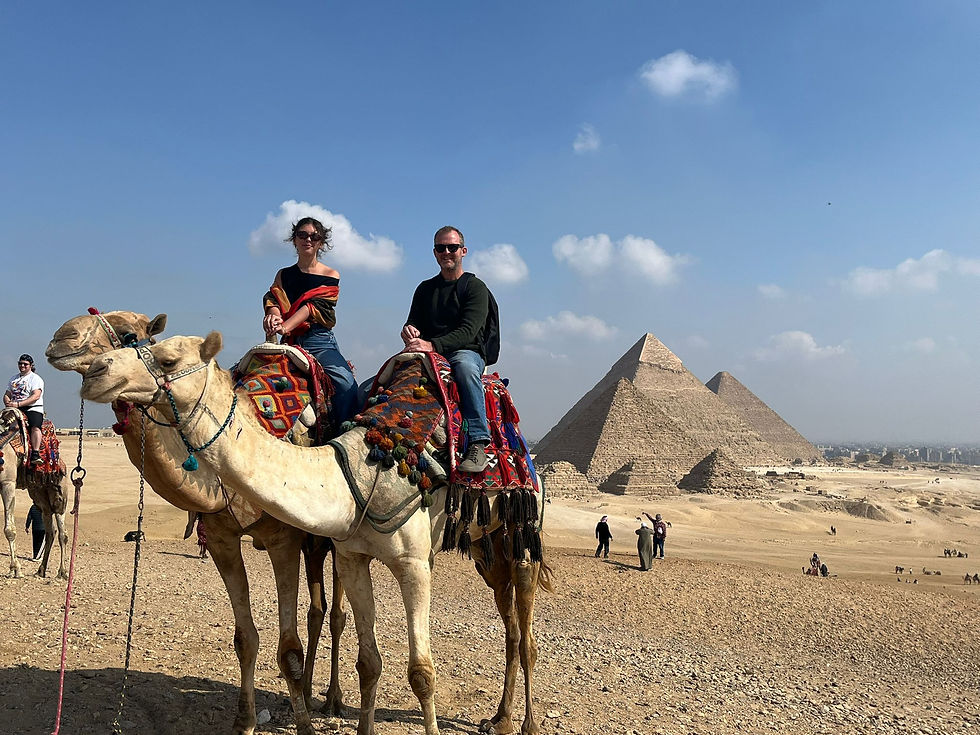
One of the most memorable parts of the visit was riding camels across the Giza Plateau.
Camels have been used for desert transport for thousands of years because they are perfectly adapted to survive in harsh environments.
They have:
• wide feet for walking on sand• long eyelashes to protect their eyes from sandstorms• the ability to go long periods without water.
Science Links
Animals Including Humans – KS2
• understanding how animals adapt to survive in their environment.
Camel Caravans

Seeing a line of camels crossing the desert helps you imagine what travel might have looked like centuries ago when traders moved goods across North Africa and the Middle East.
Geography Links
• trade routes• desert environments.
The Great Sphinx

Your photo of Sasha standing in front of the Sphinx.
The Great Sphinx is another iconic monument of ancient Egypt.
It has the body of a lion and the head of a pharaoh, symbolising strength and intelligence.
The statue was carved directly from limestone bedrock and has watched over the pyramids for more than 4,000 years.
History Links
Pupils can explore:
• symbolism in ancient Egyptian art• the role of pharaohs in Egyptian society.
Standing Beside the Great Pyramid

Looking closely at the pyramid stones is one of the most surprising experiences. Each block is enormous, and imagining how ancient builders lifted and placed them is extraordinary.
Historians believe the pyramids were built by thousands of skilled workers using ramps, sledges and careful planning.
Engineering Links
• problem solving• teamwork in large construction projects.
Why Ancient Egypt Still Fascinates Us
Egypt is one of the most remarkable ancient civilisations in history.
The Egyptians developed:
• advanced architecture• mathematics and geometry• writing systems like hieroglyphics• complex religious beliefs.
Their achievements continue to influence how we understand history, science and engineering today.
A Journey Through Time
From sailing along the Nile to standing beside the pyramids of Giza, this journey felt like travelling through thousands of years of history.
Egypt is more than a destination. It is a place where geography, science, engineering and culture come together to tell the story of one of the world’s greatest civilisations.


Comments